
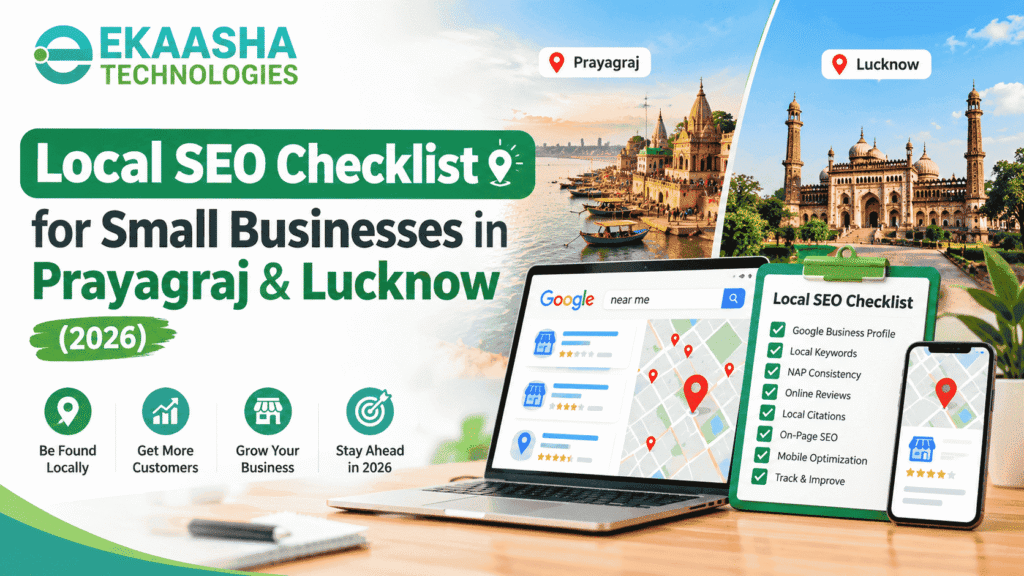

Local SEO for small businesses can help businesses in Prayagraj and Lucknow increase their visibility among prospective clients searching for products and services nearby on Google.
For a small business, being seen in that situation can mean a lot.
This is where local SEO for small businesses can help you out. This will help the search engines understand your services, location, and potential local searches for which your business could be relevant.
Local SEO is not about putting your city name at all places in your website. It needs to begin with accurate information about your business, an effective website, a well-maintained Google Business Profile, customer reviews, and content that satisfies the queries of your local customers.
If your business caters to customers in Prayagraj, Lucknow, or even in both these cities, then use this 2026 checklist.
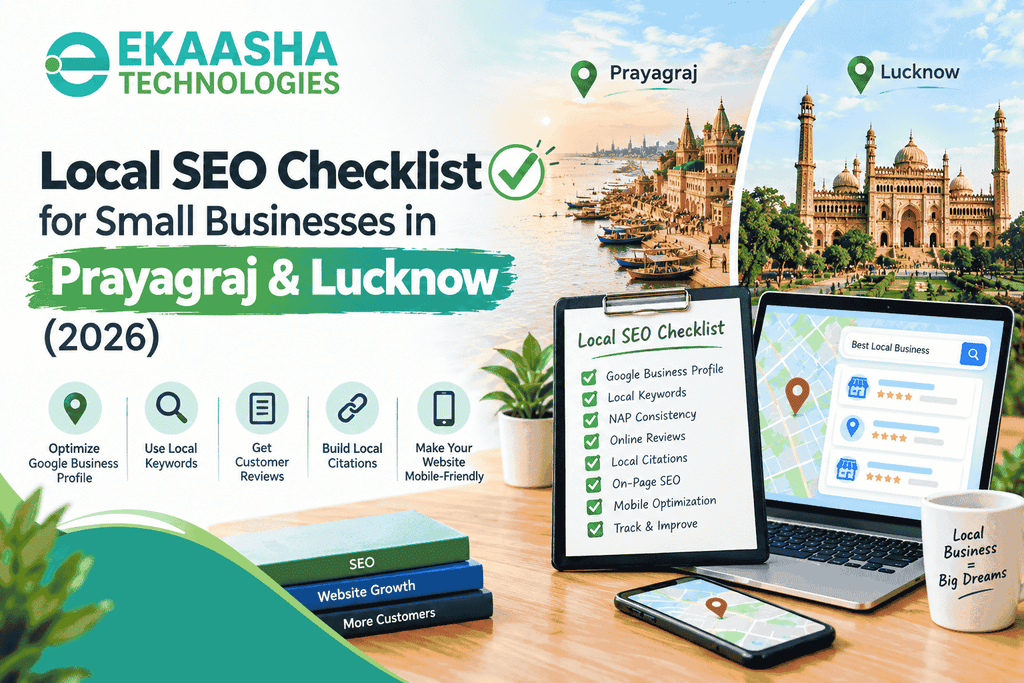
1. Complete Your Google Business Profile
The Google Business Profile is one of the first things to check when trying to increase your local visibility.
It is crucial that all data presented on the profile will match your business.
Let us start from the basics:
Business name: No services, additional locations, or promotional words should be added to the name.
Primary category: You need to choose the main business activity of yours.
Additional categories: Use these only when they genuinely represent other services you provide.
Address or service area: Customers need to clearly understand where you work.
Contact number: It must be an actual business phone number where customers can get in touch with you.
Business hours: They must always be correct, especially during holidays.
Website: It should direct to the most important page for a customer who just discovered your business.
Also, you should provide photos of your business wherever it is applicable. Photos may be of your business location, office, employees, goods, facilities, or completed projects.
It is quite easy to follow – people should learn everything about your business from Google and understand it.
2. Keep Your Business Details Consistent Online
If your website has one phone number and some other business has the old number for your business, which one will the prospective customer believe?
That’s why it’s essential that your business details remain consistent on key online locations.
Check your Name, Address, and Phone Number (NAP) on your:
- website
- Google Business Profile
- related business directories
- industries-related sites
- important social profiles
This will be even more critical after any changes in your phone number, office relocation, business hours alteration, rebranding, and opening a new location.
You don’t have to submit your company to all possible directories you come across. It is better to have a few good listings than tens of outdated or irrelevant ones.
3. Treat Prayagraj and Lucknow as Real Locations, Not Just Keywords
If you conduct your business in Prayagraj and Lucknow, you should not create two similar pages and replace only city names on each page.
The page for each location deserves its place on your site.
For instance, the page for Prayagraj can be filled with information, like the list of services offered, area covered, branch info, photos, maps, ways of contacting, and all other information which is really relevant for customers of Prayagraj.
Similarly, the page for Lucknow should provide similar information for customers of Lucknow.
That way you give a special reason for each page.
Moreover, you will not fall into the trap of creating thin pages to cover variations like “service + Prayagraj,” “service + Lucknow,” and others.
The page should be useful and answer customer’s questions related to his/her locality.
4. Understand What the Searcher Actually Wants
A search query which contains the same topic does not always have the same intent.
Let us consider these two search queries:
“How does local SEO work?”
and
“local SEO agency in Lucknow”
One person may be interested in acquiring knowledge, while the other one may be either comparing various services offered by different agencies or is interested in professional help.
It is necessary to take this into account when building your pages.
Queries with educational intent should be placed on informative websites such as guides or blogs. Service intent queries should be covered using appropriate commercial and service websites.
This matter is especially crucial in case your website already includes several SEO articles.
Rather than creating multiple pages that will fight for virtually the same keyword, you need to assign different roles to those pages.
For example:
Blog: educate the user.
Service page: describe the service and entice queries from potential clients.
Location page: provide information which would be interesting to those customers who live in this location.
5. Optimize Pages Without Forcing Keywords
A proper on-page SEO strategy does not necessarily involve inserting the target keyword within each paragraph.
Begin with the page-defining aspects:
- SEO title
- H1 heading
- URL
- Intro Paragraph
- H2 Tags and H3 Tags
- Meta Description
- Image Alt Tag
- Internal Links
Employ the main topic keyword in an organic way.
Then, begin answering the reader’s queries.
For instance, if there is an existing heading like “Local SEO Services for Prayagraj Businesses,” it is unnecessary to insert “local SEO Prayagraj” within each paragraph below the heading.
Write clearly.
Search engines should be able to understand the subject without making the content uncomfortable for a human to read.
6. Create Content Based on Real Customer Questions
A good local content creation process begins with thinking about the customer instead of starting off by filling up a spreadsheet with keywords.
Try to consider the common queries made by people before they contact you.
A clinic could be asked about appointments and treatment options. A coaching institute could be asked about courses and batches, and the admission process. A real estate agency could be asked about locations, prices, and property type.
All these are potential sources for content.
The same logic can be applied for Prayagraj and Lucknow.
Do not write an article simply because a city-based keyword exists. Write it only if there is something useful that needs to be explained to the customers.
Here’s a test you can apply:
Would the customer gain anything from this page even if the keyword was stripped off it completely?
Yes –> the page is probably informational.
No –> rethink writing it.
7. Develop a Genuine Customer Review Process
Reviews will be helpful to potential customers to know what others have gone through while dealing with the business.
Rather than viewing the reviews as a once-off exercise, make it part of your customer’s journey to request a review.
This can be done at the end of a project, after service delivery, after sending goods to the customer, or after following up on the customer.
To make the process easy, include a review link or a QR code if possible.
But do not prepare the review or instruct the customer on what he/she should say.
It is important that the review be authentic and the customer says what he/she went through.
The business needs to reply to the feedback in a professional manner.
8. Use Internal Links to Help the Reader Continue
There must be a reason for each internal link to exist.
For instance, if someone reading this checklist wants to know more about how to increase visibility for their website in Google Maps and Local Pack, they can move to Ekaasha’s Step-by-Step Guide to Ranking in Google’s Local Pack.
This is a logical internal link, since the second article goes into details about something that has been mentioned here.
In the same way, if someone who has completed their research on the topic needs some professional help, they can be referred to Ekaasha’s related SEO services page.
Do not include any link just because you need an exact-match anchor on the page.
Before adding an internal link, ask yourself this one question:
Would clicking this link genuinely help the reader at this point?
If the answer is yes, it probably belongs there.
9. Check the Local Search Experience on Mobile
An individual searching for a local business will either be doing that while traveling, shopping, making comparisons, or even getting ready to make a phone call.
It becomes particularly vital to ensure that your website is user-friendly on mobile devices.
Do not depend solely on desktop site previews.
Preview your website on a real mobile device and check whether visitors can do the following:
Check whether visitors can easily:
- read the content
- navigate the website
- tap the phone number
- find the address
- open directions
- view services
- complete an enquiry form
- use important buttons
Make sure that pop-ups, overly large images, distorted layouts, small texts, or closely located buttons are not present.
It is important not just to make it “mobile-friendly”. The task is to ensure that a local client will manage to accomplish his/her purpose of visiting the site.
10. Use LocalBusiness Schema Where It Makes Sense
Structured data provides search engines with machine-readable data about the content and entities that are represented within the web page.
In relation to a local business, some possible structured data that can be used includes the following:
- Business name
- Website
- Phone number
- Address
- Op0ening Hours
- Relevant usiness type
However, the structured data should reflect the real business and information present in the web page.
Do not include data in schema just because you think that it will help with ranking.
Schema should be understood as an interpretation of information by the search engines.
11. Build Local Authority Through Relevant Relationships
Backlinking may also serve as one of the tactics within the framework of a local business SEO campaign, but the number of backlinks should not be the goal.
Try to find places where it is logical that your business is mentioned.
It may include:
- professional associations
- local organizations
- suppliers
- business partners
- relevant events
- industry publications
- community initiatives
In case your company participates in a local event and a list of participants is published on the website of the event organizer, this mention will have both practical and search engine meaning.
It is absolutely different from putting your business information on hundreds of sites for getting backlinks.
Prioritize relevance and legitimacy.
12. Measure Business Results Alongside Rankings
Keyword rankings can be valuable but must not be considered the sole metric for local SEO results.
What if a particular keyword starts performing much better but there are still no calls and inquiries for the page?
It is important to know about this but tells nothing about how well the page serves your goals.
Track a number of metrics that will include:
Organic traffic: Is your website getting the relevant visitors through search?
Search queries: Which searches are producing impressions and clicks?
Enquiries: Are people filling your form on your website?
Calls: Are search visitors contacting the business?
Landing pages: Which pages attract useful organic traffic?
Google Business Profile interactions: What are the visitors doing once they find your Google Business Profile?
Google Search Console together with your analytics setup will give you an insight into this.
It is not about dismissing the rankings but looking at them along with actions from visitors.
A Simple Local SEO Routine for Small Businesses
It is not necessary to refresh your local SEO for small businesses plan each month.
What you really need to do is set up a straightforward review process.
Check whether there have been any changes in your business information. Examine your Google Business Profile, customer reviews, web inquiries, critical landing pages, and Google Search Console information.
Check out problems along with opportunities.
For instance, if a page has a lot of impressions but not many clicks, see if its title reflects user expectations.
If a service page gets traffic but very few inquiries, check out the page experience, messaging, contact flow, and search intent before concluding that all you need is more keywords.
Small adjustments that follow from data analysis tend to be more helpful than making alterations to pages just because it’s a new month.
Local SEO Checklist: Quick Review
Prior to wrapping up your review, ensure that:
✓ Information on Google Business Profile is correct and comprehensive.
✓ Name, address and phone information are consistent wherever required.
✓ The Prayagraj and Lucknow pages have location-specific information.
✓ Each of the vital pages has proper search intent.
✓ Titles and Headings for the pages are accurate.
✓ No unnecessary repetition of keywords occurs.
✓ You provide a simple option for customers to write genuine reviews.
✓ Important pages are mobile-friendly.
✓ Internal linking helps readers take a useful next step.
✓ Structured data includes accurate business information.
✓ Local Mentions and backlinks come from relevant sources.
✓ You keep track of customer actions and inquiries apart from rankings.
There is no compulsion of getting everything done at once.
Begin with correcting the business information, making accessibility easy, checking whether important pages are weak or duplicate and other such issues that can potentially have an impact on your customers.
Frequently Asked Questions About Local SEO
What should a small business do first for local SEO?
Begin with accuracy. Ensure that both your website and Google Business Profile accurately reflect the following details regarding your business: name, contact details, location/services area, hours of operation, and services offered. Once these basic things are taken care of, then you can focus on other elements such as content, reviews, links, and technical aspects.
Should I create separate pages for Prayagraj and Lucknow?
It would be wise to do so, provided that your business really works in those two cities and has something meaningful to say to people from each city. Do not create duplicate pages where the only difference will be the name of the city.
How often should I update my Google Business Profile?
Make updates when there are changes in the business-related information, such as business hours, contact details, offered services, location information, special days. There is no reason to make unnecessary changes just to look active.
Can local SEO improve Google Maps visibility?
Local SEO can help search engines better understand your business and its relevance to local searches. Accurate business information, a properly maintained Google Business Profile, website relevance, reviews, and other local signals can all contribute to your overall local search presence. No ethical SEO provider can guarantee a specific Maps or Local Pack position.
Do I need a lot of backlinks for local SEO?
Not necessarily. It may turn out that fewer, but more targeted mentions could bring more sense than gaining many links from irrelevant sources. Targeted links would relate to your business, your industry, and your local market.
How long does local SEO take to show results?
There is no specific answer. It will depend on many factors: your local market, your competitors, current state of your site, performed SEO earlier, etc.
It is better not to expect certain results on a certain date but pay attention to results of your business.
Our Recent Post
- Google Search Console Guide 2026: How to Improve Your SEO Performance
- Case Study: How Ekaasha Increased Organic Traffic by 300%
- Digital Marketing Mistakes That Are Costing You Customers
- How to Use Content Clusters to Dominate Search Rankings
Final Thoughts
Successful local SEO for small businesses is built around clarity and usefulness.
The business information must be accurate. The location pages must have relevant information for the customers. The Google Business Profile page should accurately describe the business, while the website must facilitate ease of access to services, contact information, and subsequent action steps.
When considering businesses operating in Prayagraj and Lucknow, it must be noted that local relevance will depend not on the use of repeated mentions of city keywords but rather on real information about these markets.
Go through this checklist, get your basics right, and then figure out what you should improve based on actual Search Console, analytics, customer, and lead data.
If you require professional assistance in pinpointing local SEO problems, the team at Ekaasha Technologies can conduct a local SEO audit of your website, Google Business Profile page, local pages, and many other SEO elements.


Pingback: Digital Marketing Cost in Lucknow: What Businesses Should Budget for in 2026