

As businesses evaluate competition, they consider companies providing similar products or services. However, this approach will not necessarily reflect the whole competitive environment.
The customer in search of a solution will not always consider two similar brands. Customers may be evaluating different services, alternative products, online solutions or choosing not to purchase anything at all.
That is why real competition analysis is essential for businesses to identify their actual competitors and understand the competitive environment in which they operate.
In order to understand whom they are actually competing with, businesses need to evaluate customer needs, purchasing behavior and alternative solutions, rather than just considering brands providing similar products.
What Is Real Competition Analysis?
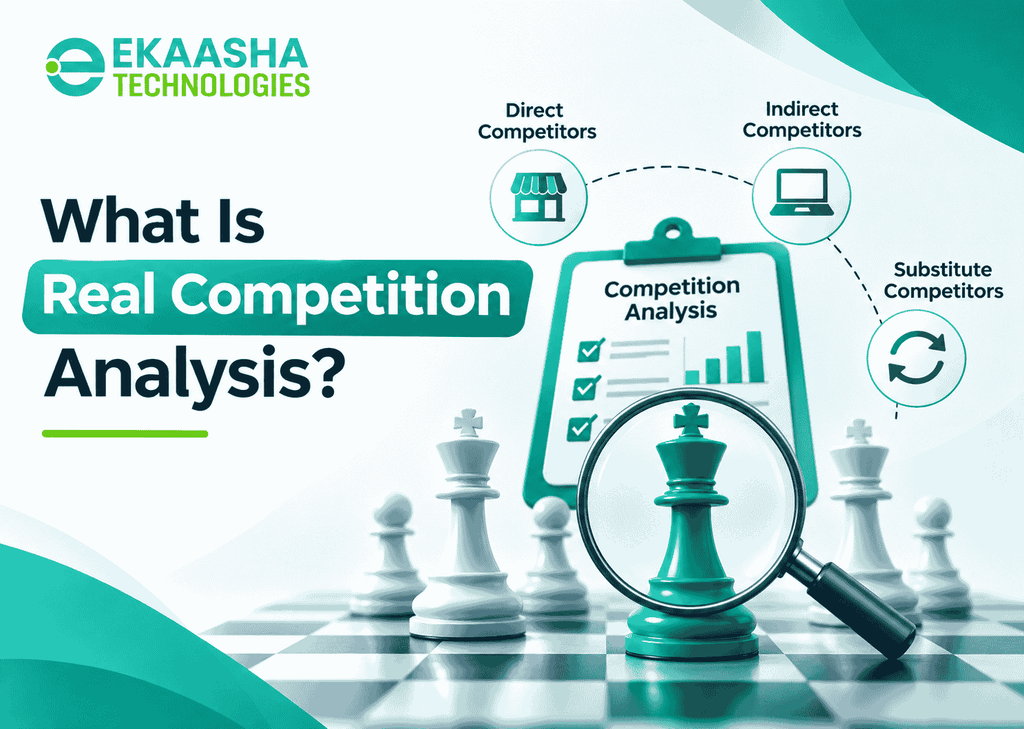
Real competition analysis is the analysis of all the companies, products and solutions that compete for the same target market.
Real competition analysis is not just about comparing firms offering products similar to those you offer. It includes evaluating whether the customers can satisfy their needs using any other product or solution.
For instance, a typical coaching institute may regard other coaching institutes as its competitors. But, there are chances that online learning platforms, recordings, and individual tuition also lure the same students.
Thus, it makes sense to analyze these competitive options as well.
1.Determine Your Direct Competitors
A direct competitor is an organization that offers similar products or services to the same target audience.
The basis for competition is normally determined by such criteria as:
- Quality of products or services
- Price or packages
- Customer experience
- Reputation of the brand
- Marketing strategies
- Convenience of access
Example:
Let’s imagine that you have a digital marketing agency in Prayagraj.
Your direct competitors could be other agencies in the same area providing services of SEO, Google ads, social media marketing and web design.
Clients who compare agencies in order to solve their marketing challenges are seeking similar services from each competitor.
What should you analyse?
- What services do competitors provide?
- Who is their target industry?
- How do they position themselves through value proposition?
- What is unique about their services?
- How high are their ranking positions on Google searches?
This information helps you understand your position in the market.
2. Understand Your Indirect Competitors
This type of competition exists where two firms provide different products/services but target the same segment of the market which has similar interests.
Though the firms are not providing the same services to the customers, yet they are competing against each other.
Example:
Let us take an example where a student has the requirement of learning digital marketing.
The options available to the student are:
- Classroom training institution for digital marketing
- Online learning portal
- Digital marketing tutor
- Certification programs
The firms are using different business models, but they are competing against each other.
3. Recognise Substitute Competition
Substitute competition occurs when customers replace a particular product or service with another alternative that fulfils the same need.
Substitute competition is particularly important because these alternatives may come from completely different industries.
Example:
Consider a person who wants to travel from Prayagraj to Lucknow.
Possible alternatives include:
- Trains
- Buses
- Private cars
- Own cars
Although these transportation options are different, they all serve the same basic purpose: helping customers travel from one place to another.
A similar example of the same can be seen where an organization wishes to increase its website visits. It can then choose between:
- SEO
- PPC Advertising
- Social Media Marketing
- Influencer Marketing
The approaches differ but can be considered alternatives of the organization.
4. How to Identify Your Real Competitors: A Practical Approach
Identifying the competitors is not just about finding similar business names via Google.
Here are some guidelines on how you can achieve this successfully:
Step 1: Know the Problem the Customer Is Trying To Solve
The first step is for you to know what exactly is the problem that your offering is going to address.
Questions to ask yourself include:
- What does the customer want to achieve?
- Why do they need a solution?
- What are the problems they want to solve?
- What alternative solutions are there?
Step 2: Google Search Research
Search for your primary services, products and customer problems on Google.
Take note of the following:
- Organic listings
- Google Advertisements
- Local listings in Google Maps
- Comparison sites
- Sites with information that influences the decision of the customers
Please remember that your business competitors and SEO competitors are not necessarily the same.
Step 3: Analyze the Customer Alternatives
Check out the choices of customers who choose something else than your business.
This can be done via customer reviews, FAQ’s, online discussion and feedbacks.
For instance, the customers say that they choose freelancers instead of agencies due to cost reasons.
Step 4: Compare Competitor Strengths and Weaknesses
Create a simple competitor analysis table.
| Comparison Factor | What to Evaluate |
| Pricing | Packages and affordability |
| Services | Products or solutions offered |
| Website | Design, content and usability |
| SEO | Organic visibility and keywords |
| Reviews | Customer feedback |
| Social Media | Content and engagement |
| Positioning | Target audience and unique value |
This comparison helps identify areas where your business can improve or differentiate itself.
Step 5: Watch out for Changing Competition
Competition does not remain static.
Changes in technology, customer needs, and business models may provide new competition.
Keep checking your list of competitors rather than doing one-off analysis.
5. Why Traditional Competitor Analysis Is Not Enough
The traditional method of carrying out competitor analysis tends to consider firms that operate within the same industry.
Even though the above method works well, there is a chance that it may fail to consider some market dynamics.
Let us consider the following example:
| Competition Type | Example |
| Direct | Two SEO agencies |
| Indirect | SEO agency vs. freelance SEO consultant |
| Substitute | SEO vs. paid advertising for customer acquisition |
This method allows the business to not only know who their competitors are but also those who may influence the purchasing decision of the consumer.
6. How Real Competition Analysis Improves Business Strategy
Businesses that comprehend their overall competitive environment can then make more effective decisions strategically.
The main advantages of the process are as follows:
Effective positioning: Know the unique aspect of your product or service compared to others.
Smart marketing: Come up with campaigns which solve the customer’s problem rather than advertise products.
Effective pricing: Know the way in which customers compare your product with other products.
Opportunities in the market: Find out the requirements of the customers which other competitors fail to meet.
Customer retention: Know the reasons for customer switching to other products and make them happy.
This can be even more helpful for businesses operating in cities such as Prayagraj and other places of Uttar Pradesh.
Frequently Asked Questions
1. What is real competition analysis?
The real competition analysis takes into consideration all business entities, products and alternatives competing for the same needs of a customer.
2. What is the difference between direct and indirect competitors?
Direct competitors provide the same types of products and services to the same group of customers. Indirect competitors offer different alternatives but they might be addressing similar needs of different groups of clients.
3. What is substitute competition?
The substitute competition is when customers go for other options to meet the same need. For example, customers might prefer going by bus rather than train.
4. How can small businesses identify their competitors?
There are many ways how small businesses can analyze their competitors: Google results, customers’ reviews, social media, industry directories and alternative solutions.
5. Why is competitor analysis important for SEO?
Competitor analysis allows businesses to find keyword opportunities, gaps in content and differences in search visibility.
Conclusion
Competitor identification goes beyond the companies who sell similar products because there are customer options that could come from an altogether different industry.
With proper competitor analysis, businesses will be able to see who are their direct competitors, indirect competitors, and substitutes affecting buying decisions.
Through the identification of customer needs, alternative products on the market and competitor strategy, businesses will be able to make better marketing decisions and gain market position.
For those business owners who want to enhance their online image, competitor analysis can offer valuable SEO insight and much more.